
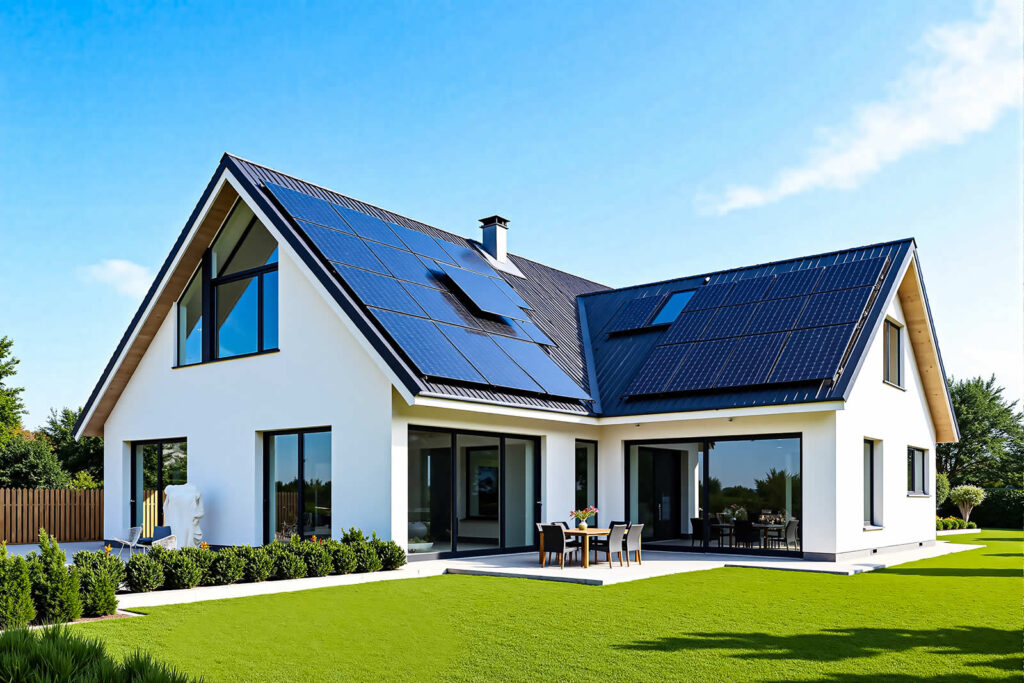
Solar panels are now a common feature on homes across the UK, helping households generate their own electricity and potentially reduce their reliance on energy from the grid.
If you are preparing to move, however, you may wonder whether selling a house with solar panels makes the conveyancing process more complicated.
In many cases, a property with solar panels can be sold without difficulty. The important thing is to establish who owns the panels, gather the relevant documentation and tell your conveyancing solicitor about them as early as possible.
Can You Sell a House with Solar Panels?
Yes. Having solar panels on your roof does not prevent you from selling your home.
For some buyers they may even be an attractive feature, particularly if the panels are owned outright and provide the household with lower-cost renewable electricity.
From a conveyancing perspective, the main question is not simply whether panels are installed. It is what legal and financial arrangements are attached to them.
Solar panels may be:
- Owned outright by the homeowner
- Owned by a third-party solar company
- Subject to a roof-space lease
- Connected with a finance or rental agreement
- Registered under an older Feed-in Tariff arrangement
A buyer’s solicitor will want to understand exactly what arrangement applies before their client commits to purchasing the property.
Do You Own the Solar Panels?
Establishing ownership should be one of your first steps.
If you bought the solar panels outright, the position will usually be more straightforward. The panels would ordinarily be sold as part of the property, but the buyer’s solicitor is still likely to ask for documentation relating to their installation, ownership and any payments associated with them.
Older installations can be more complicated.
Under some schemes, commonly referred to as “rent-a-roof” schemes, a solar company paid for the installation in return for obtaining rights over the property’s roof space. Ofgem confirms that where an installation is owned by a third party, there may be an agreement such as a roof lease between the homeowner and the installation owner.
If this applies to your home, tell your conveyancer at the beginning of the transaction.
Selling a House with Leased Solar Panels
A roof lease does not necessarily stop a property from being sold, but it can result in additional conveyancing work.
The buyer’s solicitor will need to examine the terms of the agreement and establish what rights the solar panel provider has over the property.
The buyer’s mortgage lender may also have requirements that need to be satisfied before it will lend against the property. If the existing agreement does not satisfy those requirements, further work may be necessary before the transaction can proceed.
This is one reason why identifying a roof lease early can be so important. Finding out about it several weeks into a transaction can cause avoidable enquiries and delays.
If you cannot remember which company owns the panels, do not simply assume that they belong to you. Ofgem provides a process through which information about the owner of solar panels registered under the Feed-in Tariff scheme can be requested.
What Documents Will You Need When Selling?
The more information you can provide at the beginning, the easier it will be for your solicitor to answer enquiries from the purchaser’s conveyancer.
Depending on when and how your solar panels were installed, useful documents may include:
- The original installation paperwork
- Your MCS certificate, where applicable
- Electrical installation certificates
- Building Regulations documentation, where applicable
- Planning permission or other consents, if these were required
- Solar panel and inverter warranties
- Maintenance or servicing information
- Any roof or structural survey obtained before installation
- Details of any Feed-in Tariff arrangement
- Details of any Smart Export Guarantee arrangement
- The roof lease, if the panels are third-party owned
- Any separate finance or rental agreement relating to the system
Do not worry if you cannot immediately locate everything. Tell your conveyancer what you do have and they can advise you about any additional information likely to be required.
What Is an MCS Certificate?
You may be asked to provide an MCS certificate as part of the sale.
MCS is a certification scheme relating to small-scale renewable energy installations. Documentation from the original installation can help establish details about the system and demonstrate how it was installed.
MCS certification is also relevant to certain renewable energy payment arrangements. For example, government guidance states that applicants for Smart Export Guarantee payments generally need to demonstrate that the installation and installer meet MCS requirements or an accepted equivalent standard.
If you have lost your original paperwork, it is worth investigating this early rather than waiting until your buyer’s solicitor asks for it.
What Happens to Feed-in Tariff Payments When You Sell?
Some older solar installations are registered under the Feed-in Tariff (FIT) scheme.
The scheme closed to new applications on 1 April 2019, but installations that were already accredited can continue receiving payments for their eligibility period.
If your property benefits from FIT payments, tell your solicitor and obtain the relevant information from your FIT licensee.
Ofgem’s current guidance says that owners of MCS-FIT installations should inform their FIT licensee as soon as reasonably possible when ownership of an accredited installation changes. The new owner should also receive the appropriate historical records relating to the installation.
Do not assume that payments will simply transfer automatically when the Land Registry records the new property owner. Check the procedure with the organisation administering your tariff.
What About the Smart Export Guarantee?
Newer solar installations may instead receive payments through the Smart Export Guarantee (SEG).
The SEG requires participating electricity suppliers to offer payment for eligible renewable electricity exported to the National Grid. Unlike the old FIT scheme, suppliers determine their individual tariff rates, contract lengths and terms.
If you have a SEG agreement, obtain the details before selling and contact your supplier to establish what needs to happen when ownership of the property changes.
Providing this information to the buyer can also help them understand the existing solar installation and make their own arrangements after completion.
Do Solar Panels Need Planning Permission?
In many cases, installing solar panels on a residential property in England is classed as permitted development, meaning a separate planning application is not required.
However, permitted development is subject to conditions and limitations, and there can be additional considerations for particular properties or locations.
If planning permission, listed building consent or another consent was required for your installation, your buyer’s conveyancer may ask for evidence that it was obtained.
This is another reason why the paperwork from the original installation should be kept with your property documents.
Can Solar Panels Cause Problems with a Buyer’s Mortgage?
They can sometimes lead to additional enquiries, particularly where another company owns the panels or has rights over the roof.
A mortgage lender needs suitable security over the property it is financing. A long-term roof lease or another third-party agreement may therefore need to be checked against the particular lender’s requirements.
This does not mean that a buyer cannot obtain a mortgage on a house with solar panels. It means that the relevant documentation needs to be reviewed and any issues identified early.
Where the panels are owned outright and the seller can supply clear installation documentation, the position is generally simpler than with a third-party ownership arrangement.
What If You Have a Solar Panel Finance Agreement?
Not every solar panel system was purchased with cash or through an older rent-a-roof arrangement.
If you are still paying for the system under a finance, subscription, hire or rental agreement, check the terms before marketing the property.
You will need to establish what happens to the agreement when you sell. Depending on the contract, there may be provisions dealing with early repayment, transfer to a purchaser or other requirements.
Provide a copy to your conveyancing solicitor so that the arrangement can be considered alongside the sale.
Prepare Before You Put Your Home on the Market
If you know you are going to sell, gathering your solar paperwork before a buyer is found can save valuable time later.
Try to establish:
- Who legally owns the panels
- Whether anything is registered against the property’s title
- Whether a lease or finance agreement exists
- What installation certificates you have
- Whether warranties remain valid and transferable
- Whether FIT or SEG payments are being received
- Which company administers those payments
- Whether any planning or other consents were required
The buyer’s solicitor is likely to raise questions about the panels, so having the answers available at the outset can prevent the transaction being held up while old documents are located.
Do Solar Panels Make a House Harder to Sell?
Not necessarily.
Solar panels themselves are unlikely to be the main problem. Difficulties are more likely to arise where the ownership of the panels is unclear, important documents are missing or a lease or finance agreement creates questions for the buyer or their mortgage lender.
The key is preparation.
If the panels are owned outright and you have retained the relevant paperwork, they may be little more than an additional part of the normal conveyancing enquiries.
Where there is a lease or third-party agreement, giving your solicitor the documents early provides more time to identify and resolve any issues.
Selling a Property with Solar Panels? Speak to Harrison’s Solicitors
Selling a home with solar panels may involve a few additional steps, but it does not need to make your move unnecessarily complicated.
At Harrison’s Solicitors, our experienced residential conveyancing team can deal with the legal aspects of your sale, respond to enquiries from the buyer’s solicitor and identify issues involving solar panels, leases and property documentation as the transaction progresses.
You will have a dedicated conveyancing solicitor handling your property sale, with clear communication throughout the process. Harrison’s Solicitors also provides transparent fixed-fee conveyancing and a “no sale – no fee” policy.
If you are thinking about selling a house with solar panels, speak to Harrison’s Solicitors before you move. Getting the right information together early can make the conveyancing process significantly easier for everyone involved.